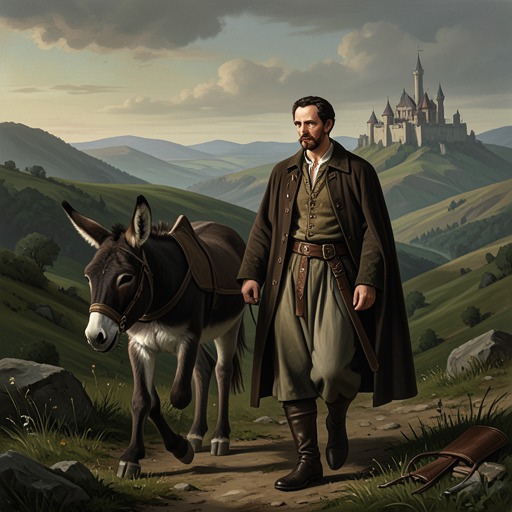
Sancho Panza’s promised governorship
Don QuixoteSancho Panza’s promised governorship converts a squire’s recurring hope of advancement into a public appointment, while exposing the unequal meanings the promise carries at The Duke’s castle. Sancho treats government as an opportunity to exercise compassionate judgment and improve his family’s prospects; his hosts treat the grant as an occasion for courtly entertainment, even as The Duchess insists that the Duke’s promise will be honored.
The Promise and Its Public Meaning
At a meal in the castle, an ecclesiastic recognizes Sancho as the squire to whom Don Quixote has promised an island. Sancho does not deny the ambition. He argues that months spent traveling with a good master have made him worthy of the reward, drawing on proverbs to present good company as a source of improvement. He imagines that he and Don Quixote will each have realms to govern, the master empires and the servant islands. His answer makes the governorship more than a prize: it is a future in which the two companions’ fortunes rise together.
The Duke then gives the promise an official form. In Don Quixote’s name, he says that he grants Sancho the government of an island of considerable importance, one at his disposal. Don Quixote directs Sancho to kneel and kiss the Duke’s feet in gratitude, and Sancho obeys. The gesture makes the appointment visible to the company, but it also makes Sancho’s advancement dependent on the favor of powerful hosts. The ecclesiastic sees not a serious change in Sancho’s standing but the indulgence of folly: he denounces the Duke for supporting the pair’s madness and leaves the table in anger. The Duke and Duchess cannot persuade him to stay, and the Duke’s laughter at his outburst underlines the divided reception of the grant.
Sancho’s claim to status has an earlier parallel in his insistence that being an old Christian is sufficient qualification to become a count. Don Quixote answers that, as king, he could make Sancho noble without purchase or service. The exchange shows how readily Sancho imagines inherited rank and titles becoming accessible through a powerful patron. The island government is a different promised reward, but it likewise places his hopes within a system where recognition from above can transform his social position.
Sancho’s Account of Good Government
The Duchess tells Sancho to be of good cheer: her husband will keep his promise despite the envy and malice of others. She describes the future governor as taking possession of his island’s dignity, and charges him to govern his vassals carefully, reminding him that they are loyal and well-born. Her reassurance keeps the promised office alive, while her language presents government as a responsibility toward subjects as well as an elevation in rank.
Sancho answers with his own account of the work. He says he is naturally kind-hearted and compassionate toward the poor, and promises not to deprive workers of the bread they have earned. The good, he says, will receive support and protection; the bad will find neither a foothold nor access. Rather than claim formal instruction, he argues that a start is what matters: after a fortnight as governor, he thinks he may take to the work and understand it better than the field labor in which he was raised. The confidence is comic in its speed, but its substance is a practical ideal of rule built around fairness, protection, and attentiveness to the poor.
The Duchess accepts that governing is learned rather than innate, comparing the making of bishops to the making of men. She then returns the conversation to Dulcinea del Toboso’s enchantment. Sancho’s account of deceiving his master, she insists, is itself mistaken: the peasant girl was Dulcinea, and Sancho is the one deceived by enchantment. Her claim supplies a second, competing account of what Sancho should be attending to even as he prepares for office. The promise of government does not remove him from the castle’s elaborate play of belief and misbelief.
Appointment, Whipping, and the Letter Home
Before taking up the government, Sancho gives the Duchess an open letter addressed to his wife, Teresa Panza. In it he reports that he has obtained a government and that he expects to leave for it within days. He links the office to the lashes he is supposed to give himself to disenchant Dulcinea, presenting his advancement as having come at the cost of a whipping. The letter also carries the promise into family life: Sancho says he intends Teresa to travel in a coach because she will be a governor’s wife, and sends her a green hunting suit from the Duchess to alter into clothing for their daughter.
The letter makes ambition concrete but not uncomplicated. Sancho admits that he has a strong desire to make money, explaining that he has heard new governors begin with that desire. He does not claim certainty about what the office will bring; he says he will test the situation and then let Teresa know whether she should join him. His attachment to Dapple is equally explicit: the donkey is well, sends his regards, and will not be left behind, whatever higher distinction Sancho might be offered. Household prospects, possible wealth, and loyalty to his familiar companion all sit beside the grand title.
The Duchess identifies two faults in Sancho’s account. First, she says the government was not granted in exchange for lashes: when the Duke promised it, nobody had yet thought of the whipping. Second, she worries that Sancho presents himself as too eager for money, since a covetous governor may administer justice badly. Her corrections separate the appointment from the enchantment plot and turn his private hopes into a question of public conduct. Sancho offers to tear up the letter and write another if it is unsuitable, but the Duchess lets it stand and says she wants the Duke to see it.
The Promise’s Stakes
The governorship remains, in these scenes, a promise about to be put into effect rather than a record of Sancho’s rule. The Duchess says that the pair will settle how he can soon enter the government; Sancho’s letter, dated July 20, 1614, likewise describes his departure as imminent. The distinction matters: his claims about compassion, fairness, and readiness are intentions and predictions, not evidence of what he later accomplishes in office.
The episode holds several versions of advancement together. Sancho imagines a real responsibility and a change in his family’s standing; Don Quixote treats the grant as the fulfillment of his own promise; The Duke formally confers the government; and the angry ecclesiastic regards the whole arrangement as folly. The Duchess’s confidence and criticism make her role equally double-edged: she assures Sancho that the Duke will keep his word, yet examines his account of why he received the office and whether his appetite for money threatens just rule. The promised governorship therefore tests not only whether Sancho will rise, but what he believes a ruler owes to those placed under his care.